 PupShift
Daylight saving time and your dog: a family plan for the clock change
In short
Your dog doesn't know the clocks changed, so the week before, move meals, walks and bedtime a little at a time toward the new times. Write the new times where the whole family sees them, plan for darker evening walks, and keep one record so nobody feeds twice in the confusion.
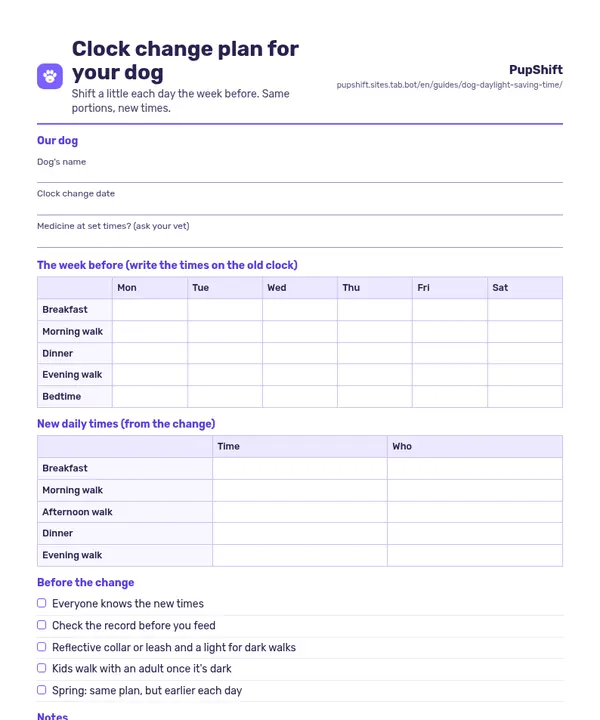 PDF · A4Clock change plan for your dogDownload PDF
Twice a year the clock jumps and your dog doesn't get the memo. In the fall, the clocks go back an hour, so a dog who eats at 7:00 is suddenly hungry at what the clock calls 6:00, and the evening walk happens in the dark. Spread the change over a few days and agree on the new times as a family, and it's barely noticeable. The example family: Pepper the dog, Mom, Dad, Noa (11) and Ari (7).
Mark the date and the new times
In the United States, daylight saving time ends at 2:00 a.m. on the first Sunday of November, according to NIST. In 2026 that's Sunday, November 1. In the UK the clocks go back on the last Sunday in October, which is Sunday, October 25, 2026, per GOV.UK.
Put the date in the family calendar now, and decide what Pepper's day will look like on the new clock. Most families keep the same clock times as before (breakfast at 7:00, dinner at 18:00), which means the dog has to wait an hour longer than her body expects on the first day. That's the hour you'll spread out.
Shift the routine a little each day
The American Kennel Club's advice is to ease into it: in the week before the time change, gradually adjust your dog's schedule for eating, walking and bedtime. Chewy's guide, reviewed by a veterinarian, says the same thing: gradual adjustments ahead of the change make the transition easier.
For the fall change, that means moving things a little later every day or two, so by Sunday the dog is already on the new times. One way to do it:
| Day | Breakfast (old clock) | Dinner (old clock) |
|---|---|---|
| Mon | 7:10 | 18:10 |
| Tue | 7:20 | 18:20 |
| Wed | 7:30 | 18:30 |
| Thu | 7:40 | 18:40 |
| Fri | 7:50 | 18:50 |
| Sat | 8:00 | 19:00 |
| Sun (new clock) | 7:00 | 18:00 |
By Saturday, breakfast at 8:00 on the old clock is 7:00 on the new one, so Sunday feels normal. Move walks and bedtime along with the meals. This only changes when the dog eats, not how much. Portions stay the same, and if your dog takes medicine at set times, ask your vet how to handle the change.
Starting late? Even two or three days of small steps beats a sudden jump. And if your family's own times are changing anyway (a later school run, a different shift), use the change to settle on the routine you actually want.
Put the new times on the fridge
The clock change is a classic moment for double feeding. Dad sees Pepper staring at her bowl at 6:15, "she must be hungry", and feeds her. Mom comes down at 7:00 and does the same.
Prevent it with two things:
- One sheet with the new times, where everyone sees it. The printable on this page has the week-before plan and the new daily times on one page.
- One record of who fed and walked, marked right away with a name and time. During the change week especially, check before you feed.
Our dog feeding schedule guide has more on setting meal times and avoiding double feeding. Tell the kids too. Ari fills Pepper's water bowl every morning, so he needs to know breakfast is a bit later this week.
Plan for darker walks
Once the clocks go back, the after-work or after-school walk can suddenly be in the dark. Plan for it:
- Move the walk earlier if someone is home, or swap who does it. In our example, Noa's after-school walk moves straight to 16:00 while it's still light, with Mom alongside.
- A reflective or light-up collar or leash, and a light for the person walking.
- Kids walk with an adult once it's dark.
- Familiar, well-lit routes for the first weeks.
If the walk times move, it's a good moment to redo your dog walk rotation so the dark slots don't always land on the same person.
Watch the first few days
Chewy's guide lists signs a dog is feeling the change: restlessness or grogginess, whining or pacing around mealtimes and walk times, waiting at the door early, or accidents in the house. A few unsettled days are common, and a patient, steady routine usually settles them. If something seems off or doesn't settle, check with your vet.
Dogs also notice when people leave and come home at different times. Keep goodbyes and hellos calm that week.
In the spring
In the spring the clocks go forward (in the US on the second Sunday of March, per NIST), so you do the same thing in reverse: in the week before, move meals and walks a little earlier each day. The AKC's reminder fits here: you'll do it all again, in reverse, in a few months.
Where PupShift fits
PupShift keeps one shared board for the whole family. Whoever feeds or walks Pepper taps Fed or Walked, and everyone sees who did it and when, which is exactly what you want in a week when everyone's body clock is a little off. If someone taps Fed again within 2 hours, the app checks first and shows who already logged the meal.
This is general information, not a substitute for advice from a vet or trainer. If something seems wrong with your dog, call your vet.
Sources
- How Does Daylight Saving Time Affect Dogs? American Kennel Club
- Are Dogs Affected by Daylight Saving Time? Chewy (reviewed by a veterinarian)
- Daylight Saving Time NIST
- When do the clocks change? GOV.UK
Checked on the update date.
This is general information, not advice from a vet, trainer or other professional.